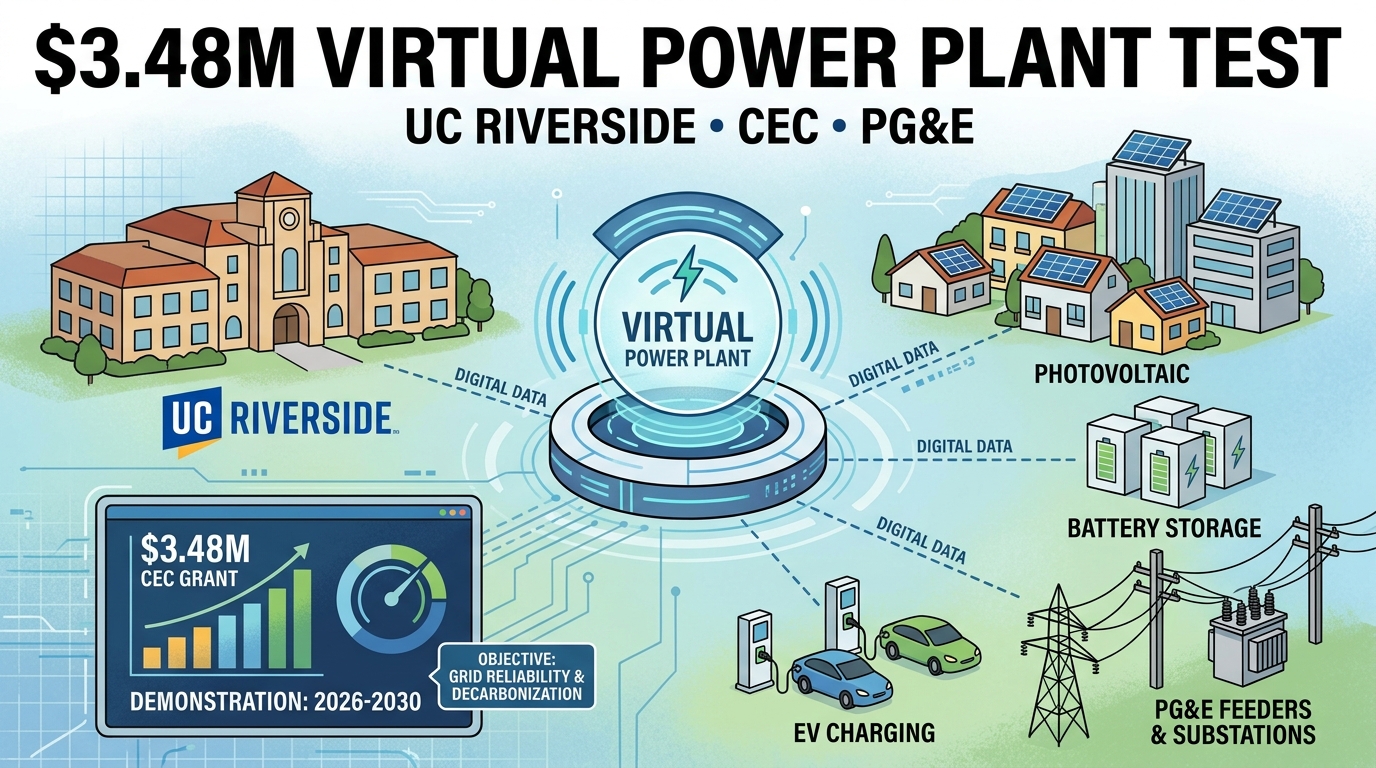
The California Energy Commission is proposing a $3,483,212 EPIC grant to the University of California, Riverside, for a utility-integrated virtual power plant demonstration across multiple PG&E substations and feeders serving disadvantaged communities.
The CEC’s Oct. 19 business-meeting packet identifies the proposed recipient as The Regents of the University of California, on behalf of its Riverside campus, under Agreement EPC-26-010. The project, titled “Coordinated VPP for Distribution-Level Services,” is scheduled to run from Nov. 2, 2026, through Nov. 1, 2030.
The system would coordinate battery energy storage, electric-vehicle supply equipment and photovoltaic resources enrolled through Olivine Inc.’s Climate Response VPP program. The scope calls for pre-installation grid simulations and baseline assessments, followed by demonstration-level integration with PG&E systems to exchange dispatch signals and operational information.
The project would test localized services such as congestion mitigation, reactive-power support, power-quality improvements and managed EV charging under utility operating conditions. Its scope also includes community outreach and enrollment in disadvantaged communities, along with an analytical framework for valuing and compensating distribution-level grid services.
The proposal calls for a full-year field demonstration, with data collection on asset responses, system availability and operational limitations. Independent third-party measurement and verification would assess the system’s performance and responsiveness. The packet lists PG&E as an unfunded utility partner and says the integration would avoid impacts to PG&E’s existing production systems and operational responsibilities.
CEC materials describe potential benefits including improved reliability and power quality, and the possibility of deferring traditional distribution upgrades. Those outcomes are proposed objectives, not results established by the materials; the demonstration and evaluation have not yet occurred.
The item was listed for the commission’s consent agenda, but the resolution’s AYE, NAY, ABSENT and ABSTAIN fields are blank in the supplied packet. The materials therefore do not establish whether the commission took final action. The packet also does not identify the specific PG&E feeders, substations or participating communities.