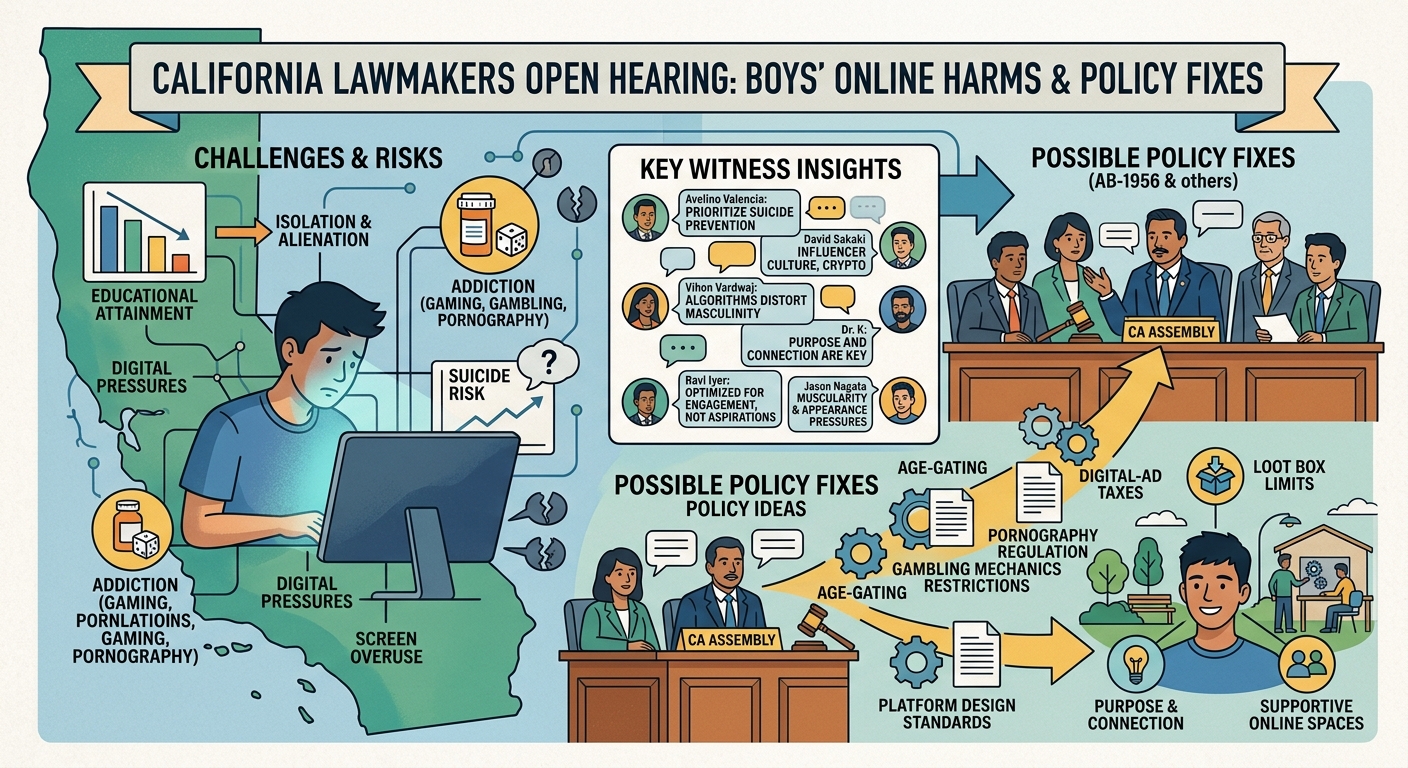
Assembly Member Avelino Valencia opened the inaugural hearing of the Assembly Select Committee on developing pathways to purpose for young men by saying California should do more to support boys and young men facing disconnection, low educational attainment, isolation, addiction and suicide risk.
Valencia tied the effort to his bill AB-1956, which he said would make young men and boys a priority in the state’s suicide-prevention efforts. The committee’s first hearing also turned quickly to policy ideas, with members and witnesses discussing age-gating, pornography, gambling mechanics in games, digital-ad taxes and other possible responses.
Committee members said the issue reaches beyond individual choices or parenting. Assemblymember Alvarez talked about screen-time concerns from a parent’s perspective, while other members raised the role of social media, privacy and safer online spaces.
On the first panel, David Sakaki of the American Institute for Boys and Men said young men’s online lives can run from pornography to gaming, sports betting, crypto speculation and influencer culture. Vihon Vardwaj of Generation Up said algorithms and online culture can intensify insecurities and distort ideas about masculinity and relationships. Dr. Alok Kanjroja, known as Dr. K, said his own past video game addiction pushed him toward psychiatry and that purpose and connection are central to recovery.
A second panel focused on how platforms are designed. Ravi Iyer, a USC researcher and former Meta employee, said services are optimized for engagement rather than users’ aspirations. Jason Nagata of UCSF said boys can face harms both from overuse and from the content they see, including muscularity-focused posts and appearance pressures. Speakers and lawmakers also pointed to policies used elsewhere, including limits on gambling ads, loot box restrictions and digital-advertising taxes.
The hearing did not end with a vote or formal recommendation, but it marked an early public airing of how California lawmakers may try to turn concern about boys’ online lives into legislation or other policy changes.